
Norway: Thousands of Youth Demonstrated against “Green Colonialism”
On March 3, the largest civil disobedience action in recent Norwegian history came to an end. 16 Sami activists occupied the lobby of the Oil and Energy Department, and over 1,500 demonstrators attended in Oslo, including around 100 activists partaking in the occupations. Beginning as a single day occupation to spread awareness about the illegal construction of wind turbines on Indigenous land, the demonstration ended as a burgeoning, semi-mass movement.
World’s Richest Nations Are ‘Exporting Extinction’ With Demand for Agricultural and Forestry Imports: Study
The study is the first to quantify the degree of countries’ contributions to worldwide biodiversity loss when they shift the environmental impact of their consumption abroad.
“By importing food and timber, these developed nations are essentially exporting extinction,” said David Wilcove, the study’s co-author and a professor of ecology, evolutionary biology and public affairs at Princeton. “Global trade spreads out the environmental impacts of human consumption, in this case prompting the more developed nations to get their food from poorer, more biodiverse nations in the tropics, resulting in the loss of more species.”
By Shanna Hanbury / Mongabay
High-income nations are wiping out wildlife far beyond their own borders by outsourcing their production of food and timber, according to a new study that shows their demand for these commodities fuels 15 times more habitat destruction overseas than at home.
Researchers found that wealthy nations account for 13% of global forest habitat loss outside their own territories. The United States alone is linked to 3% of the world’s deforestation outside its borders. Other top contributors include Germany, France, Japan, China and the United Kingdom.
“We knew in principle that countries trading with each other should be impacting a lot of species elsewhere. But this was the first time we could actually measure it,” lead author Alex Wiebe, a researcher at Princeton University, U.S., told Mongabay by phone. “We suspected that there would be a lot of outsourced impacts, but we didn’t think it was necessarily going to be that high, especially relative to domestic impacts.”
Agricultural expansion drives an estimated 90% of global habitat loss, with particularly severe impacts in megadiverse countries like Brazil and Madagascar. In these regions, every ton of soy, vanilla or beef produced in deforested areas carries a disproportionate cost to wildlife.
Researchers analyzed habitat loss for more than 7,500 species of birds, mammals and reptiles between 2001 and 2015, and identified the industries driving it. Among the 404 critically endangered species assessed, 95% lost habitat during this period. One-sixth of that loss was linked to consumption in 24 high-income nations.
The destruction wasn’t evenly distributed: countries tended to harm sensitive ecosystems closest to them. Central America was the region most impacted by U.S. consumption outside of U.S. borders, while China and Japan had the greatest impact on Southeast Asian rainforests. But Madagascar faced heavy pressure from wealthy nations across the globe.
“The U.S., but also the U.K., China, Japan and Germany, all had disproportionately high impacts on species in Madagascar, which is surprising given how far it is away from them,” Wiebe said. The reasons aren’t entirely clear, but Wiebe said it may be a combination of rich biodiversity and the aggressive expansion of crops for export, like vanilla. “Madagascar produces about three-quarters of the world’s vanilla, even though it’s not native to Madagascar,” he added.
Andrew Balmford, a conservation scientist at the University of Cambridge, U.K., said the study underscores the disproportionate role that wealthy nations play in global biodiversity loss.
“At a time when nations and policies show worrying signs of becoming more inward-looking, this study provides some of the starkest evidence yet that consumers in richer countries usually have far greater impact on biodiversity in other countries than at home,” Balmford said in an email.
“Conservation problems cannot be solved by ignoring the long-range impact of the choices we as consumers, voters and decision-makers take,” he added.
As more countries pursue alternatives to fossil fuels, Mongabay is increasingly reporting on how “clean energy” transitions affect communities and wildlife in mineral-rich regions. Our coverage has highlighted how Indigenous people, local communities and fragile ecosystems often pay the price for the world’s growing demand for transition minerals like nickel, graphite, copper, lithium and cobalt. Recent examples of coverage include:
- Rapid growth of Bolivia’s lithium industry creating new problems for local communities
- Global cobalt rush drives toxic toll near DRC mines
- Madagascar: What happens to villagers when a graphite mine comes knocking?
- Landslide in Philippines mining town kills nearly 100, prompts calls for action
- Impunity and pollution abound in DRC mining along the road to the energy transition
- Java rice farmers suffer crop failure as copper mine pollutes local irrigation
- Nickel mine threatens Philippines biodiversity hotspot on Sibuyan Island (analysis)
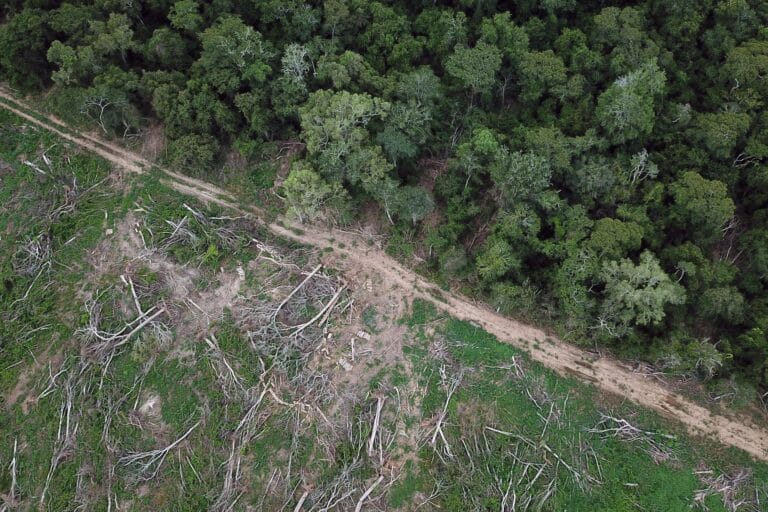
Banner image: Deforested Chiquitano forest on the edge of the Bolivian Amazon for soy production. Image by Rhett A. Butler/Mongabay.
Discover more from BlueEarthDefense
Subscribe to get the latest posts sent to your email.
One Response