
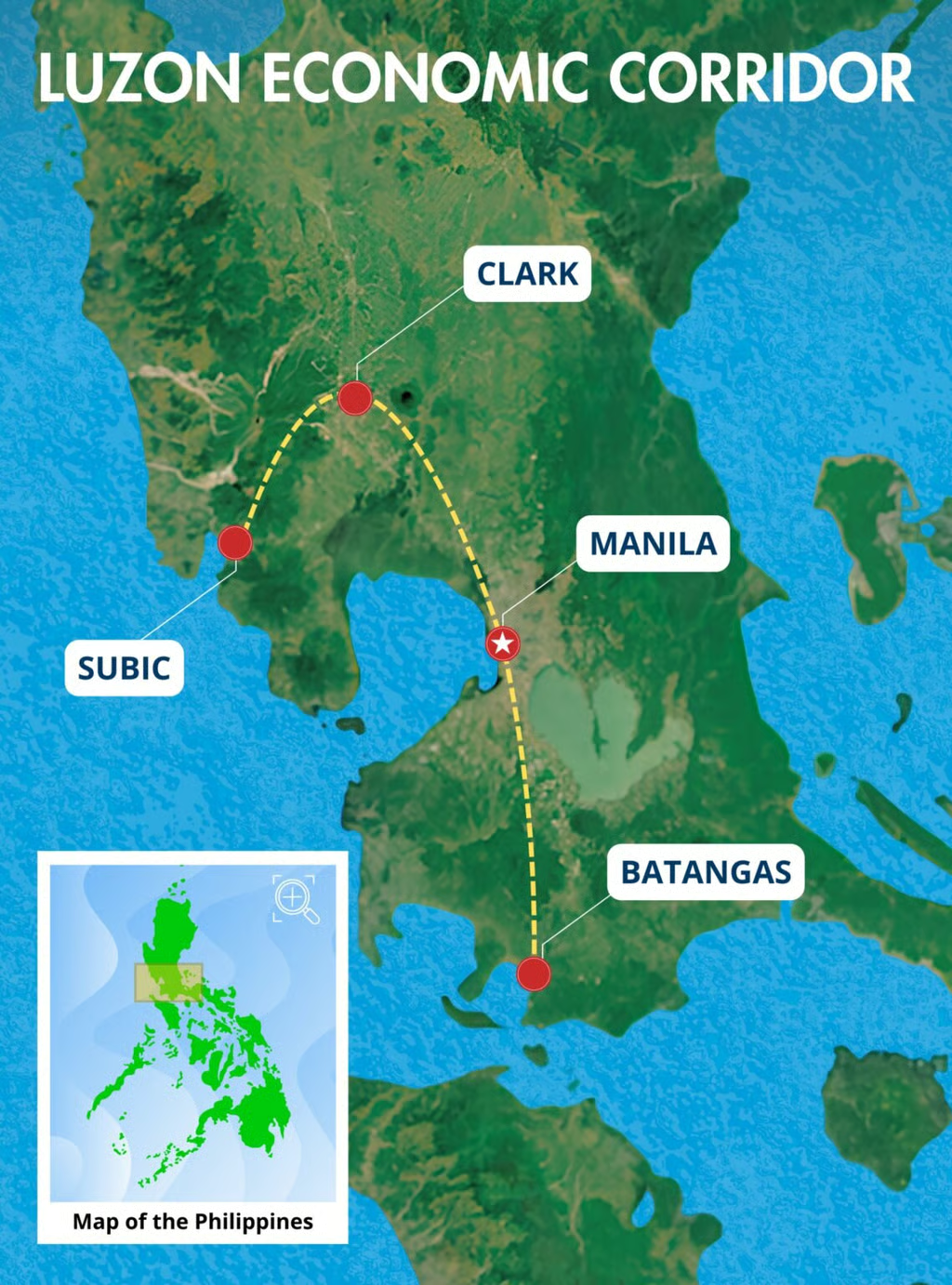
“MANILA — United States Undersecretary of State for Economic Affairs Jacob Helberg personally inspected the future site of an artificial intelligence or AI-native industrial hub at the New Clark City in Capas, Tarlac.
Helberg met with Philippine Trade Undersecretary Ceferino Rodolfo and Bases Conversion and Development Authority President and CEO Joshua Bingcang.The over 1,600-hectare(4,000-acre) Economic Security Zone will soon become home to a constellation of integrated manufacturing sites, logistics corridors, and other facilities related to AI, semiconductors, and other technology components.”
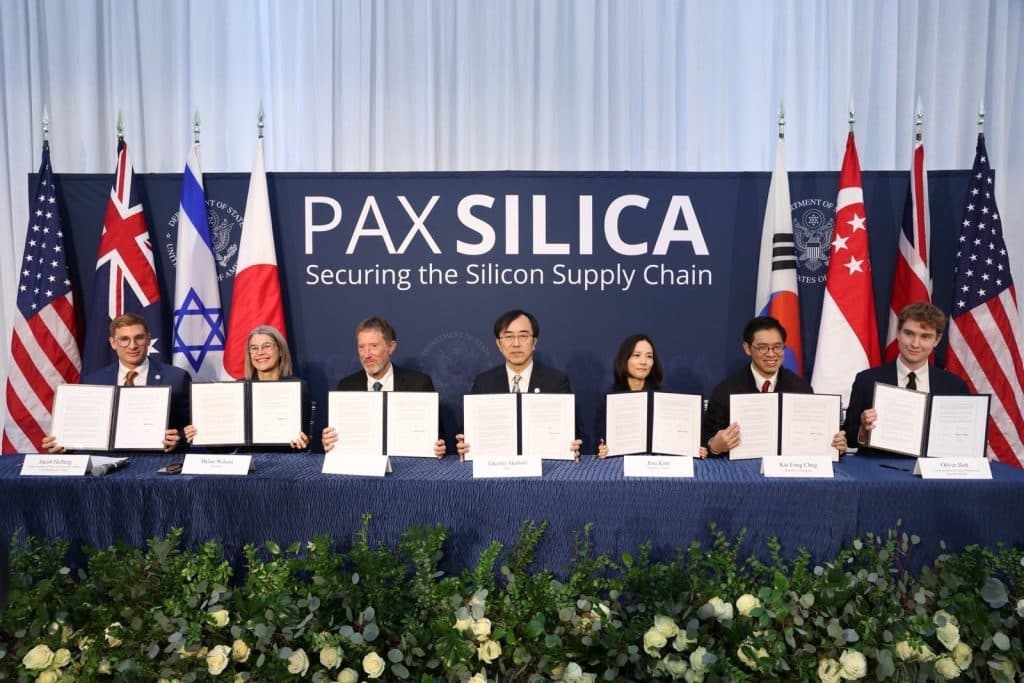
The endeavor called Pax Silica is a US-backed initiative that seeks to build more secure supply chains for semiconductors, artificial intelligence infrastructure, critical minerals, and advanced manufacturing.”
“The Philippines formally joined Pax Silica in April, becoming the 13th member of the coalition, which seeks to establish trusted supply chains for semiconductors, artificial intelligence technologies, critical minerals, and other strategic industries.
The science advocacy group AGHAM has argued that science and technology policy should prioritize domestic industrialization, climate resilience, public health, food security, and civilian technological development.The organization has cautioned that technology initiatives should ultimately strengthen national scientific capabilities and not simply respond to geopolitical competition among major powers.”
Manila runs the risk of antagonising Beijing by betting on partly speculative investment pledges by Western partners, especially the Trump administration.”“The European Union is set to join Pax Silica, a Washington-led initiative to coordinate export controls and co-investment in advanced chips aimed at curbing China’s technological rise, particularly in AI.
In recent weeks, Brussels has been debating whether to sign up to the initiative, which the US launched last December to secure global supply chains for AI chips, critical minerals and advanced technologies. The UK, Japan, South Korea, India and Australia have already joined, as have three EU member states — Greece, Finland and Sweden.
The initiative has not been without its critics, however. France has been among the most vocal sceptics, framing it as nothing short of an attempt to colonise Europe and at odds with the EU’s tech sovereignty agenda, which seeks to reduce strategic dependence on foreign suppliers, including American ones.
Germany, Italy and the Netherlands, by contrast, were firmly in favor, stressing the need for the EU to present a united front towards Washington.”
“Yet Pax Silica also exposes the core tension in American strategy: partnership versus leverage. Coalition frameworks require predictability and trust, but many participants face renewed tariff threats and other unilateral US measures. Conflicting tools risk undermining the reindustrialisation agenda that Pax Silica presupposes – especially if partner countries face trade penalties while being asked to invest in long-term industrial projects. When economic relationships are increasingly treated as instruments of statecraft, how can allies and partners ensure that ‘America First’ imperatives do not eclipse the more collaborative mode that Pax Silica seeks? In that sense, Pax Silica may be the most sophisticated expression of US critical-minerals diplomacy, but the hardest to sustain.
For allied governments, Washington’s renewed emphasis on international cooperation is broadly welcome – but it comes with strings attached. Greater state involvement, opaque deal structures and tacit political commitments complicate partners’ assessments of costs, risks and long-term reliability. Rather than being a genuinely coequal framework, Pax Silica builds on a hierarchical model where Washington defines the rules and calibrates access. Some actors are brought in as ‘capability nodes’, while others – notably the EU and Taiwan – are treated more as markets rather than full strategic co-architects.
For firms, domestic and international, especially those accustomed to government-backed capital, the current moment may look like a windfall. Yet US government support will increasingly be conditional: access to US finance, diplomatic backing, offtake guarantees or equity participation will hinge on strategic expectations – onshoring capacity in the US and aligning investment decisions with American national-security priorities.”
“The contemporary crisis of global capitalism is multidimensional. Structurally it is a crisis of overaccumulation, which refers to a situation in which enormous amounts of capital (profits) are built up but this capital cannot find productive outlets for reinvestment. This overaccumulation crisis generates intense pressure for expansion as transnational capitalists undertake a predatory search for where to unload massive amounts of surplus capital and open up new spaces for profit-making. This violent expansion involves the seizure of markets and resources around the world through war, displacement, and repression. The U.S. state and beyond it, what we will call Global Trumpism, is its out-of-control instrument in this expansionary wave. At the core of Global Trumpism is the Washington-Tel Aviv axis.
If Global Trumpism succeeds, it will become a testing ground for its vision to dominate the future: Pax Silica, or the merger of the high-tech military-surveillance complex and transnational finance.”
“For three decades after the Cold War, the U.S. approached global technology supply chains primarily as efficiency problems – optimizing for cost and scale while assuming geopolitical disruption was a tail risk rather than a design constraint.
That model unraveled in stages: first as China emerged as a strategic rival; then during the Covid-19 pandemic, and now with the USreal war on Iran. which exposed how concentrated supply chains failed under stress; and finally with the recognition that advanced AI is not simply another digital service, but a general-purpose capability with direct military, economic and political consequences. Once AI came to be understood as an infrastructure of power, treating its supply chain as a neutral market outcome became untenable.
Pax Silica represents the most explicit break yet with the post-1990s era. Rather than attempting to reshore everything – a task that is economically infeasible – the U.S. is pursuing something more selective: control over the narrow points where the entire system can be constrained. Scale matters, but chokepoints matter more.”
Understanding Pax Silica in the Philippine Context: AI, Critical Minerals, and Emerging Industrial Governance
Prepared by: Blue Earth Defense Philippines (BED PH) Date: May 2026
I. Introduction
The Philippines’ participation in the Pax Silica Initiative marks a significant shift in its development trajectory. With the establishment of an AI-industrial hub in New Clark City, the country is being integrated into a rapidly expanding global system centered on artificial intelligence (AI), semiconductor production, digital infrastructure, and critical mineral supply chains.
Pax Silica is often framed as a pathway toward modernization, technological innovation, industrial development, and economic growth. However, it also raises important questions regarding sovereignty, ecological sustainability, labor systems, resource governance, and the long-term direction of national development policy.
This document is intended as an awareness and discussion paper. Rather than promoting a fixed conclusion, it aims to help communities, students, civil society organizations, workers, policymakers, and the broader public better understand the emerging systems connected to Pax Silica and their possible implications for the Philippines.
The paper examines Pax Silica not only as an industrial initiative, but as part of a broader global restructuring involving AI, climate transition, digital infrastructure, geopolitical competition, and critical mineral extraction.
II. What is Pax Silica?
Pax Silica is a United States-led multinational initiative aimed at:
- ● securing supply chains for AI and semiconductor industries
- ● ensuring access to critical minerals
- ● developing networks of “trusted partners” in strategic industrial sectors
- ● strengthening industrial resilience amid geopolitical competition
It emerged within the context of:
- ● global supply chain disruptions
- ● intensifying geopolitical rivalry over advanced technologies
- ● rapid expansion of AI-driven digital infrastructure
- ● growing demand for semiconductors and critical minerals
- ● the global transition toward renewable energy and electric mobility
Structurally, Pax Silica functions simultaneously as:
- an economic coordination framework for industrial and technological development; and
- a geopolitical alignment strategy connected to supply chain security and strategicinfluence.
Because of this dual character, Pax Silica is increasingly discussed not only in economic terms, but also in relation to sovereignty, industrial dependency, ecological impacts, and global power relations.
III. Core Objectives of Pax Silica
Pax Silica advances several major objectives:
1. Supply Chain Security
Ensuring stable access to semiconductors, critical minerals, and AI-related industrial inputs.
2. Industrial Expansion
Developing AI hubs, semiconductor facilities, data infrastructure, and advanced manufacturing zones.
3. Technological Leadership
Strengthening competitiveness in artificial intelligence, telecommunications, and emerging digital systems.
4. Strategic Alignment
Integrating participating countries into coordinated economic and technological networks.
IV. Policy Architecture
The initiative is supported through several institutional and economic mechanisms, including:
- ● special industrial zones and economic corridors
- ● public–private partnerships
- ● investment incentives and regulatory flexibility
- ● integrated extraction-to-production supply chains
- ● digital and telecommunications infrastructure expansion
- ● cross-border industrial coordination agreements
These mechanisms are designed to accelerate industrial integration and technological development.
V. The Philippines’ Role within Pax Silica
Within Pax Silica, the Philippines is positioned as:
- ● a supplier of critical minerals such as nickel, copper, cobalt, and chromite
- ● a host economy for AI and semiconductor-related industries
- ● a strategic node in Indo-Pacific industrial geography
- ● a site for digital infrastructure expansion, including data centers and telecommunications systems
This positioning may create opportunities for industrial investment, infrastructure development, and integration into emerging technology sectors.
At the same time, it also raises broader discussions regarding:
- ● long-term economic dependency
- ● domestic value capture
- ● ecological impacts of extraction
- ● labor conditions
- ● technological sovereignty
- ● the country’s role within global supply chains
VI. Expanded Industrial System: Beyond AI
VI.1 Telecommunications and Digital Infrastructure
The expansion of digital infrastructure—including 5G networks, data centers, cloud systems, and satellite technologies—requires substantial quantities of:
- ● copper
- ● lithium
- ● rare earth elements
- ● nickel
- ● cobalt
This highlights that AI development depends on highly material-intensive infrastructures involving extraction, manufacturing, energy use, and industrial logistics.
Digital systems are often perceived as “virtual” or immaterial, yet they rely heavily on physical infrastructure and resource-intensive production systems.
VI.2 Dual-Use Technologies and Security-Linked Systems
Technologies associated with Pax Silica—such as semiconductors, AI systems, satellites, and telecommunications infrastructure—are commonly categorized as dual-use technologies, meaning they may serve both civilian and security-related functions.
Examples include:
- ● semiconductors used in consumer electronics and defense systems
- ● satellites used for communication, navigation, and surveillance
- ● AI systems used in logistics, public services, and security analytics
This raises an important analytical question:
Is Pax Silica purely a civilian-oriented industrial initiative focused on innovation and economic development, or does its structure also connect participating countries to broader security-linked technological systems?
The issue here is not necessarily intent, but the structural overlap that may emerge between economic systems, strategic technologies, and geopolitical competition.
VI.3 Climate Mitigation and the Electric Vehicle Transition
Climate mitigation technologies such as solar panels, wind turbines, hydropower systems, batteries, and electric vehicles (EVs) are widely promoted as solutions to the climate crisis. However, these systems also require large quantities of:
- ● lithium
- ● cobalt
- ● nickel
- ● copper
- ● rare earth elements
This means that the global transition toward renewable energy and digital systems may significantly increase demand for mining and resource extraction.
As a result, countries rich in critical minerals—such as the Philippines—may experience intensified extraction pressures connected to global industrial and climate-transition systems.
VI.4 The Global South and Extraction Zones
Many countries in the Global South serve as major sources of raw materials needed for industrial production, digital infrastructure, and energy transition technologies.
This has led to increasing discussions around concepts such as:
Green Colonialism
A term used to describe situations where climate and sustainability initiatives depend on intensified extraction in resource-rich but structurally unequal regions.
Techno-Colonialism
A concept referring to conditions where technological systems, digital infrastructure, data governance, and supply chains become mechanisms that reinforce unequal global power relations and dependency structures.
These concepts are increasingly discussed within debates on AI expansion, renewable energy systems, and critical mineral supply chains.
VII. Key Questions and Areas for Public Discussion
The expansion of Pax Silica and related industrial systems raises several important questions for public discussion:
Economic and Development Questions
- ● Who benefits most from industrial integration into global AI supply chains?
- ● Will the Philippines move beyond raw material export dependence?
- ● How much domestic value creation and technological transfer will occur?
Ecological Questions
- ● What are the environmental impacts of expanded mining and industrial infrastructure?
- ● How will extraction affect watersheds, forests, coastal areas, and agricultural land?
- ● Can large-scale industrial expansion occur within ecological limits?
Labor and Social Questions
- ● How might automation and AI affect labor systems and employment?
- ● What protections exist for workers and affected communities?
- ● How are Indigenous Peoples and local communities involved in decision-making?
Governance and Sovereignty Questions
- ● How transparent are agreements involving industrial zones and foreign partnerships?
- ● Who controls data systems, digital infrastructure, and strategic technologies?
- ● What level of national sovereignty is maintained within global supply chain systems?
Geopolitical Questions
- ● How does Pax Silica relate to broader geopolitical competition?
- ● What are the implications of integrating into strategic technological networks?
- ● Can industrial cooperation remain separate from geopolitical tensions?
VIII. Key Concepts for Understanding Pax Silica
This discussion paper uses several concepts commonly found in environmental, political, and development analysis
1. Extractivism
An economic model based on large-scale extraction of natural resources for export-oriented production.
2. Green Colonialism
A framework describing how some climate-transition systems may rely on intensified extraction in the Global South.
3. Techno-Colonialism
A concept examining how control over technology, digital infrastructure, and data systems may reinforce unequal global power relations.
4. Dual-Use Systems
Technologies that may serve both civilian and security-related purposes.
5. Post-Growth Perspective
An approach questioning whether continuous economic expansion is compatible with ecological limits and long-term sustainability.
From this perspective, development is evaluated not only through GDP growth, but also through:
- ● ecological stability
- ● social well-being
- ● equity
- ● resilience
- ● sustainability of communities and ecosystems
IX. Why This Discussion Matters
The rapid expansion of AI systems, semiconductor production, digital infrastructure, and renewable energy technologies is reshaping global economic systems.
At the center of this transformation are questions about:
- ● minerals and extraction
- ● energy demand
- ● industrial governance
- ● technological control
- ● ecological sustainability
- ● labor and communities
- ● geopolitical competition
The Philippines is increasingly becoming part of these emerging systems.
Understanding Pax Silica therefore requires looking beyond technology alone and examining the broader economic, ecological, political, and social structures connected to it.
X. Conclusion
Pax Silica represents more than an industrial initiative. It reflects the ongoing transformation of global systems of production, technology, extraction, and strategic governance in the age of AI and climate transition.
The emergence of these systems raises important questions about the future direction of development, the role of critical minerals, the expansion of digital infrastructure, and the relationship between technology, ecology, sovereignty, and global power.
As the Philippines becomes more integrated into these emerging industrial networks, broader public understanding and democratic discussion become increasingly important.
This document is intended not as a final answer, but as a starting point for awareness, dialogue, critical reflection, and collective discussion.
References and Sources
Government and Official Release
- ● Philippine News Agency. (2026). PH joins US-led Pax Silica; plan for industrial hub in Luzon unveiled. https://www.pna.gov.ph/articles/1273139
- ● Bases Conversion and Development Authority. (2026). New Clark City to serve as AI hub under US-led Pax Silica Initiative.
- https://bcda.gov.ph/news/new-clark-city-serve-ai-hub-under-us-led-pax-silica-initiative
News and Media Reports
- ● The Philippine Star. (2026). Philippines, Israel in talks for cooperation on minerals, AI. https://www.philstar.com/business/2026/05/04/2525420/philippines-israel-talks-cooperation-minerals-ai
- ● Rappler. (2026). Norway will join ‘Pax Silica,’ the US-led effort to secure AI supply chains. https://www.rappler.com/technology/norway-joins-pax-silica-initiative-ai-supply-chains/
- ● SunStar Pampanga. (2026). Pax Silica and the Philippines. https://www.sunstar.com.ph/pampanga/pax-silica-and-the-philippines
- ● Other references
- ● PHILIPPINES SIGNS MOU ON CRITICAL MINERALS SUPPLY CHAINS https://philippineembassy-dc.org/philippines-signs-mou-on-critical-minerals-supply-chains/
- ● PHILIPPINES-ISRAEL DEEPEN STRATEGIC COOPERATION, ON CRITICAL MINERALS AND AI DEVELOPMENT UNDER PAX SILICA, TO FORGE FRAMEWORK https://boi.gov.ph/philippines-israel-deepen-strategic-cooperation-on-critical-minerals-and-ai-development-under-pax-silica -to-forge-framework/
Discover more from BlueEarthDefense
Subscribe to get the latest posts sent to your email.